June 25, 2026
Countering the Violence of Abortion the FFL Way
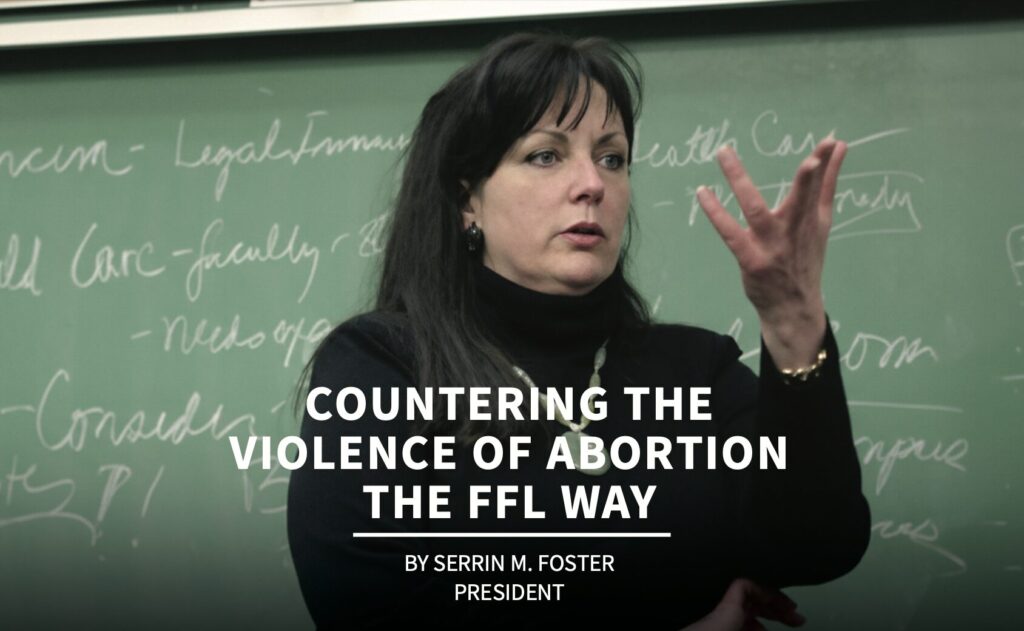
As I prepare to retire after 32 incredibly meaningful years at Feminists for Life, I want to leave you one last gift: How to counter the violence of abortion through dialogue.
It starts with a goal. Are we trying to prove we are right—or prove someone else wrong? Or are we trying to have a conversation where we listen for issues and offer real help?
How do we view someone who is attacking pro-life principles at an event or family gathering? Do we start by recognizing them as someone who has never known a day without abortion? Or who has suffered one? Perhaps they are defending someone else’s decision.
Are they the enemy—or someone we are here to serve?
But often it is all about how abortion has been packaged: Freedom (or the illusion of it); Rights (at the expense of another); negative thoughts about motherhood (even as we have documented the benefits of motherhood to women).
We are here to free women from abortion and correct a great wrong that has taken the lives of more than sixty-six million children…and counting.
So no snark—and no debate games of “gotcha.” Whether it’s online or in person, it might feel good at the moment, but it never helps. It never makes people feel you care about them. And it will rarely if ever change someone’s mind or soften their heart. Sadly, we’ve seen this pointless back and forth online. Paul Swope, Founder of LifeNet Services, wrote about this in an excellent First Things article called “A Failure to Communicate.”
Recognize that anger often masks pain. Leave the door open.
Of course there are trolls and screamers. Some are really hurting from their own abortions or feel we are attacking their family member or friend. We aren’t psychologists, and likely can’t get through to them.
So don’t feel pressured to invest your time in a pointless debate.
But those who are genuinely curious about Feminists for Life know that I really enjoyed meeting them. I have walked up to protesters, by myself, not with a bunch of allies with me. I say hello and thank them for caring for women and for their willingness to listen to me before or after I presented “The Feminist Case Against Abortion.”
Recognize that many have never known a day without legal abortion, and after Dobbs, they see us as taking their freedom and wanting to control their “rights.” They haven’t seen the long-term pain and sorrow like those of us who remember a pre-Dobbs world have.
Let them know they are welcome here and recognize in your heart that they also care about women—and let them know you see it.
Then logically explain why abortion is antithetical to feminism. After all, the foundational principles are nonviolence, nondiscrimination, and justice for all. The best short answer is “women deserve better than abortion.” Most get it, maybe not in that moment, but truth gnaws its way in the mind.
The first wave feminists, who were first to take up the prolife cause, recognized as we do, that abortion is a reflection that we have not met the needs of women. Women deserve better.
Today, most women who suffer abortions are the poorest among us.
They are young and disproportionately women of color.
Some face a “Sophie’s choice” thinking they must choose between the child already born, or the child in their womb. How fair is that? Help them Question Abortion™.
As Feminists for Life, we listen to their challenges and advocate women-centered solutions. Housing, childcare, during maternity, postpartum, and when their child is sick. A living wage. Education and workplace solutions along with paternal support can significantly improve her situation.
At this point, invite them to help women with three steps: Welcome. Inform. Invite.
No one wants to be embarrassed. Humiliation pushes people farther away. Like abortion, it solves nothing.
Results: This is how we won the parliamentary style debate at Yale, the first in the nation.
This is why my jewelry box has precious letters that I will be sending with our archives to the Arthur and Elizabeth Schlesinger Library on the History of Women in America at Harvard.
One is from a woman who was planning to go to med school to become an abortion provider and who changed her mind after my speech at the University of Pittsburgh. She added that she would not even refer a woman to an abortion.
A national TV host whom I met with to help her prepare to lobby on the Hill for the “Year of the Woman” shared our message that “Women deserve better than abortion” to an abortion activist next door. She invited her to just read our website. The neighbor came back and said she couldn’t disagree with anything we said.
A woman sent a note of apology years after hearing me at the University of Delaware, “I came to mock you, but you made me feel bad in a good way.”
- She changed her mind and reported that she was now working FOR women and children. And the list of impactful moments grew.
- Starting in 1997 at Georgetown University, students from campuses across the nation agreed to host an FFL Pregnancy and Parenting Resource Forum℠.
- Another at UVA heard our call to serve the unmet needs of women. She started a babysitting group and eventually became pro-life, too.
- Students on both sides of the contentious debate worked together for a pregnant student in the audience at Wellesley. By selling old blue jeans, refrigerators, schoolbooks, and more, they raised thousands for her to have housing when she could not stay in the dorm after the baby was born. She graduated and her story was shared in a major women’s publication.
- Berkeley students sold cupcakes to raise funds for diaper decks.
- Others distributed our WomenDeserveBetter.com brochures that inform and help, rather than debate. After all, no woman should feel forced to choose between her educational career plans that could raise her and her family out of poverty—and her daughter or son.
THIS is why you invested in Feminists for Life. THIS is what you sacrificed for.
I invite you to internalize these simple steps. I didn’t learn them as a speech major. I just knew how I wanted to be treated—and thought that most people would like to be treated with kindness and respect. Rakes and pitchforks don’t work quite so well, do they? It might intimidate, but it never convinces.
Being right simply isn’t good enough. We must be effective.
Never forget, like our suffragist foremothers who announced a new day, we are heralds. A better day is coming if we speak out and work together for justice, for all. March forth!
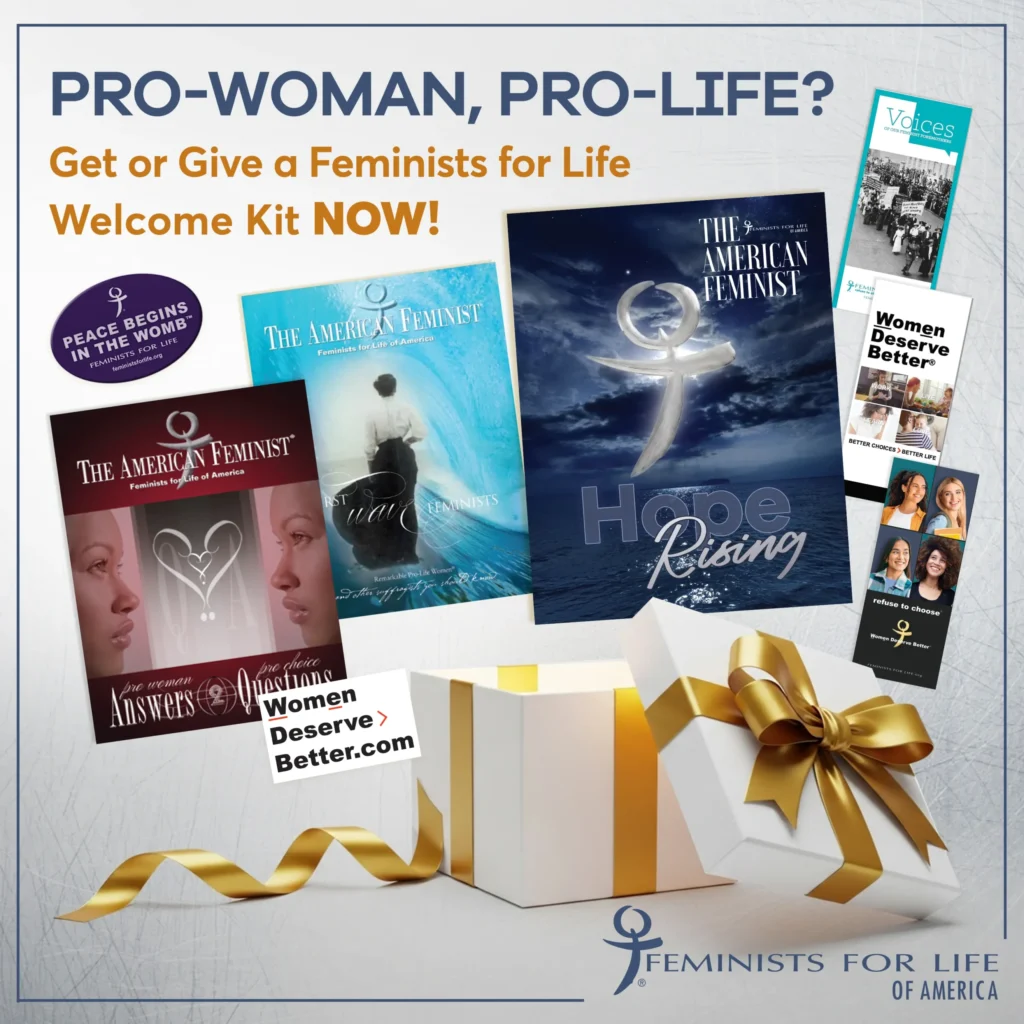
Editor’s note: This article is from “Hope Rising,” the 2026 issue of The American Feminist. The entire issue is available in a Welcome or Welcome Back Kit.