
What about rape?
What if it was your daughter who was raped?
Answer from a survivor:
“In every discussion or debate surrounding abortion, the quintessential question of “What about rape?” is raised. Abortion, for some, is only reserved for these toughest of cases.
But should it be?
Can we equally support victims, advocate for justice for them, while also defending the innocent life that has been created in the harshest of circumstances?
As Feminists for Life, we answer YES. We refuse to choose between the woman we have always championed for and the innocent life dependent on her.
As a survivor of rape, who found myself pregnant afterwards, I appreciate the desire to not want to put the additional stress of an unplanned pregnancy on me. I appreciate the thought that the pregnancy may bring with it triggers and memories of the horror of the crime. And I understand the fear that perhaps this pregnancy will forever tie me to my perpetrator.And if healing was that simple, that easy to deconstruct, maybe the solution would be, too. But there is not one way to heal, nor is there only one outcome to pregnancy after rape.
For many survivors, the child conceived becomes the one good thing to come of the horrific crime; still others state the abortion procedure was intensely triggering and only added another layer of trauma from which to heal.
For me, the realization that there was as much of me in this child as there was the potential rapist-father was powerful. Have we as feminists not moved on from the archaic belief that only paternity matters in a person? Surely the crimes of rapists do not define their children, for what about the strength of their mothers?
We do not rank our dignity, our equality, or our right to exist on the circumstances of our conception.”
From Serrin:

I would love her and my grandchild unconditionally, and I would do everything in my power to prosecute the perpetrator to the fullest extent of the law.
Out of our desire to save someone from suffering, it is normal to wish we could erase a painful memory such as rape. Unfortunately, the hard truth is that as much as we want to, we can’t.
Abortion doesn’t erase a memory. Think about it.
At my lecture at Vanderbilt University, a medical student told other students that abortion is a second act of violence against a woman who is raped, and said her “abortion was worse than the rape.”
Both victims — the woman and her child — deserve our unconditional support.

Pregnancy can be punishing, but a child is not a punishment. When Julie Makimaa was reunited with her birthmother, Lee Ezell (“Victory Over Violence,” The American Feminist, vol. 5, no. 3), Julie asked her if it would have been better for Lee if Julie was never born at all.
Lee told Julie that she was the “only good thing to come out of the rape.”
When someone asks about exceptions for rape and incest, we must also consider how that makes those feel who were conceived through sexual assault.
Well-meaning statements can hurt. As one UC-Berkeley grad student said to her pro-choice peers, “I have a right to be here.”
They responded, “We didn’t mean you!” She asked, “Whom did you think you meant?”
My mother told this story to a coworker who agreed and said, “People never think they are talking to an exception — like me.”
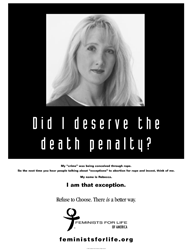
Could you look at someone conceived in violence and tell her that she never should have been born? What if it turned out to be your best friend — or a relative? Would that change the way you felt about her? Would you think less of her mother? Rebecca Kiessling, a young attorney and mother who was conceived through sexual assault, asks, “Did I deserve the death penalty?” Can you imagine if we ranked the value of people based on the circumstances of their conception?
We don’t discriminate based on parentage — that’s not equality! You are valuable no matter who your parents are, no matter the circumstances of your conception.
People used to value a woman based on who her father or husband was. It is similarly medieval to value a child by the actions of her father. That way of thinking is patriarchal and antifeminist, and it should have gone out with the Dark Ages.
Abortion after rape is misdirected anger. It doesn’t punish the perpetrator of the crime or prevent further assaults against other women.
FFL’s priority is keeping women safe. Incarcerated sexual offenders should not be allowed pornography, barbells, and early release. We need harsh sentences for sexual assault without possibility of parole.
We need comprehensive support for rape victims who become pregnant. A convicted rapist should never have paternal rights or be able to demand visitation from “his” children while in prison. But if he has the means, he should contribute child support. If a woman is poor and cannot prove the paternity, she could have problems collecting welfare. Small employers could fire her. We need to listen to those who have had children conceived through sexual assault and work for short- and long-term solutions that benefit both.
Feminists for Life is a proud supporter of the Violence Against Women Act. In fact, we were the only pro-life group active in the National Task Force on Sexual Assault and Domestic Violence.
After a lecture at a midwestern university where I shared the story of Lee and Julie, a student pulled me aside. She told me that she was raped by her third cousin as a mere thirteen-year-old and had became pregnant. Her parents had helped her have the privacy she wanted during her pregnancy, and then she placed her son with two loving parents.
I asked her, why did she make the decision to have the child — when she was just a girl who had lived through what was arguably the worst of circumstances? She said she would never pass on the violence that was perpetrated against her to her own unborn child. Now that is the strength of a woman!
Because women deserve better,
Serrin M. Foster
President
Feminists for Life
